By Loretta Mohl
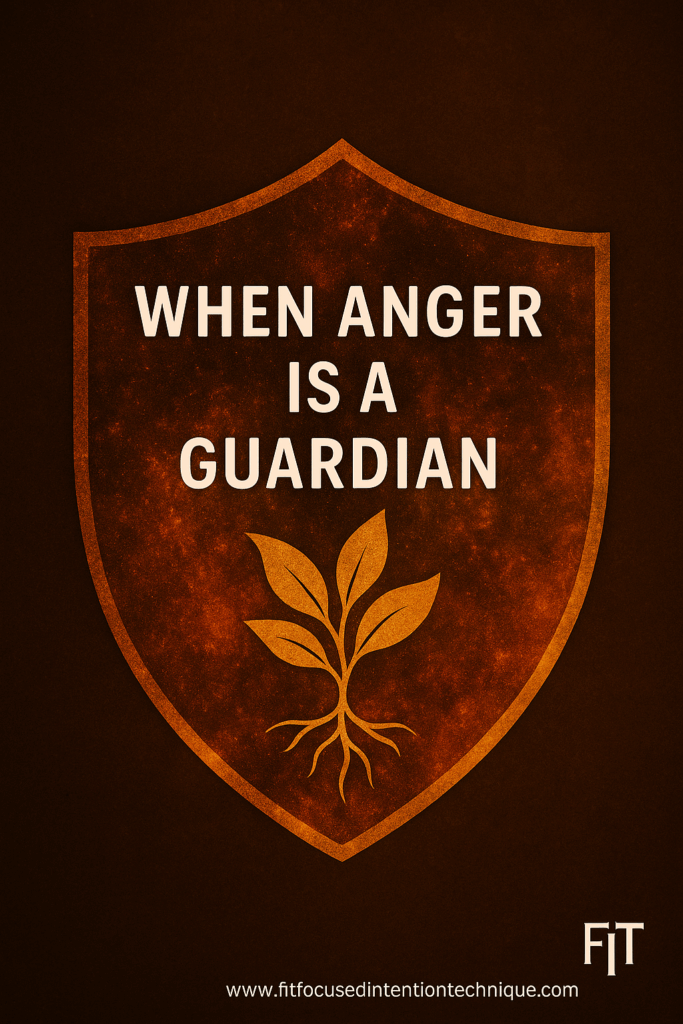
Image below: The leaves symbolize rootedness, growth, and life force—the true essence beneath the anger. Here’s how the image speaks symbolically:
- The shield represents protection—the part that stood guard when you were vulnerable.
- The fire is anger transformed—once destructive, now alchemical, a source of energy and clarity.
- The leaves growing within the fire show that what once seemed like destruction is actually the fertile ground for growth, truth, and embodiment. It’s life emerging from what was once defense.
Together, it reflects the sacred truth: you were never just the anger—you were the root, the fire, and the guardian all along.
Here’s What’s Never Talked About When It Comes to Anger
Most people avoid anger. It’s uncomfortable. It’s unpredictable. It can destroy relationships or leave deep scars.
We’re taught to fear it, suppress it, judge it—or distance ourselves from those who express it.
We don’t talk about anger—not in ourselves, not in others.
We avoid it in conversation just as much as we avoid it in presence.
Because let’s be honest—anger can be so unattractive. So overwhelming. Such a turnoff.
And after the anger explodes?
We’re often left in the wreckage—drenched in guilt, flooded with shame, and confused by the depth of our reaction.
That’s when the real exile begins.
We deny.
We withdraw.
We hide.
Not just from others—but from the part of us that still needs love.
That’s the part I want to talk about today.
But here’s the truth that’s rarely spoken:
Anger is not the enemy.
Anger is often a protector. A signal. A voice for what was never allowed to be said.
This is why I’m sharing my story. Because beneath the fire is a truth so sacred, it’s been buried in silence.For much of my life, I carried a deep undercurrent of anger. Not surface frustration—but a core fire that could rise suddenly, fiercely, and sometimes frighteningly. It didn’t match how I felt inside—because honestly, I’m a joyful person. But this anger was different. It felt ancient. It felt inherited. And no matter how much healing work I did, it stayed.
It was the part of me I wanted most to change.
The part that made me feel separate from others.
The part that disrupted my nervous system and scared people I loved.
The part I felt ashamed of… and yet couldn’t let go.
That core of anger became my catalyst. It’s what drove me to search for real healing. Not coping. Not managing. Healing.
And in time, I realized something essential:
The anger wasn’t the enemy. It was a guardian.
It had been protecting me since I was small—when there was no room for softness, no space to cry, and no one safe to turn to.
My father carried anger. So did my grandfather. So do my siblings. It’s an intergenerational fire I inherited, but I refused to pass it on.
In my healing, I learned something that changed everything:
We don’t need to get rid of the part. We need to reclaim it.
Because anger isn’t just rage—it’s protection. It’s the body’s way of saying, “Something has been violated. Something needs care.”
And when we try to exile that part, it only grows louder.
But when we meet it with curiosity, gentleness, and love—when we say, “I see you, I hear you, and you don’t have to do this alone anymore”—the part softens. It no longer has to protect us in the same way. It can evolve.
In my work with the Focused Intention Technique, I now help others do the same:
- Identify the part that has been protecting them (often in the form of anger, control, withdrawal, or overachievement).
- Understand what that part needed in order to survive.
- Reclaim it—not to act out through it, but to invite it home.
- Give it a new role: one that’s aligned with who they truly are.
Anger isn’t your identity. It’s not your flaw.
It’s the body’s way of guarding the sacred until it feels safe enough to heal.
If you’re walking with a fiery part right now, try asking:
- What were you protecting me from?
- What do you really need?
- What would your new role be if you felt safe?
The answers may surprise you.
They may soften you.
They may bring you back to the heart of who you are.
You’re not broken.
You’re remembering.