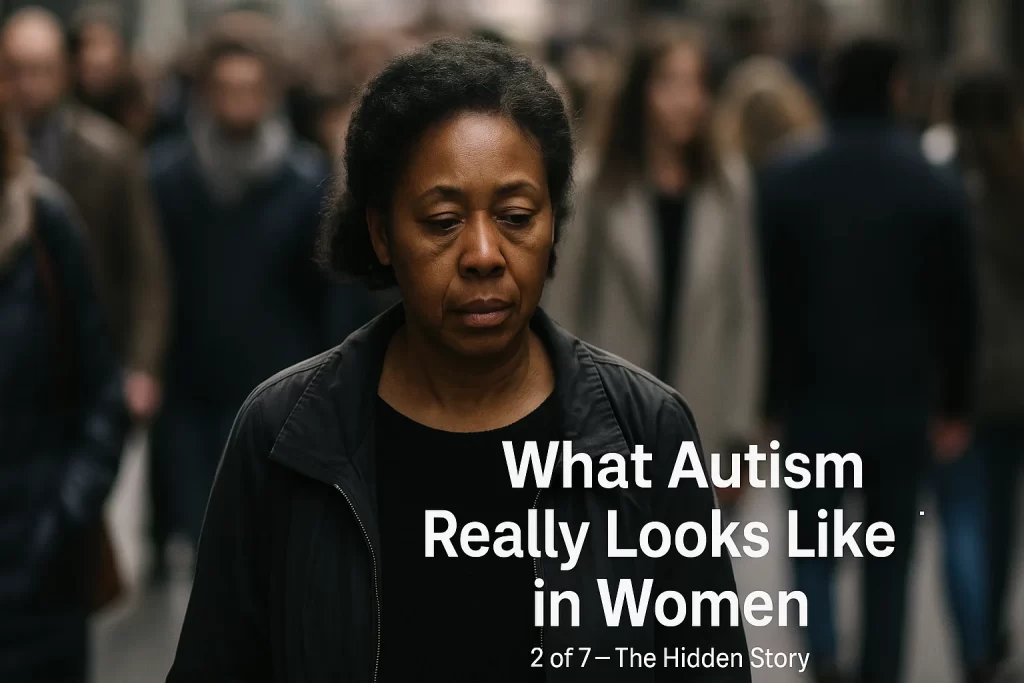
What Is Autism, Really? Understanding the Spectrum and the Gift
This is not a diagnosis.
This is a remembering.
Most of us were never told what autism really is — especially how it can show up in women.
We were told what it looks like in boys:
rocking, meltdowns, withdrawal, silence.
We were not told that autism can also look like:
perfectionism, people-pleasing, social exhaustion, or emotional overwhelm.
We were told what it means to be “normal.”
But no one ever told us we were brilliant — just wired differently.
What Is Autism?
At its core, autism is not a flaw.
It’s not a disorder.
It’s a different way the brain processes and relates to the world.
It often involves:
• Highly sensitive sensory perception (light, sound, smell, emotion)
• Intense focus (sometimes called “special interests”)
• Deep empathy or emotional attunement
• Pattern recognition (seeing connections others don’t)
• Difficulty with small talk or surface social rules
• Struggles with overwhelm, transitions, or uncertainty
These are not failures — they are gifts, when understood and supported.
The Spectrum Is Wide — and Misunderstood
Autism is not a box. It’s not a checklist.
It’s a spectrum — which means it includes a wide range of experiences and needs.
Some women speak freely. Others go nonverbal under stress.
Some can hold down careers while silently melting down at home.
Others are visibly struggling and judged for not “trying hard enough.”
The term “high-functioning” is often used — but it’s misleading.
Functioning isn’t about how we look.
It’s about how much we’re hiding.
Why Women Were Missed
The truth is, women and girls don’t present the same way as boys.
We were trained to mask.
To smile, to perform, to be polite.
And we were good at it — too good. So good that we were never seen.
Many women with autistic traits were:
• Misdiagnosed with anxiety or depression
• Put on medication for symptoms instead of being understood
• Told they were “too sensitive,” “too emotional,” or “too dramatic”
None of that was true.
It just wasn’t the kind of autism anyone was looking for.
Autism, ADHD, and Trauma — It’s Not Always One Thing
You might not know what to call it.
Maybe you resonate with autism. Maybe ADHD. Maybe complex trauma.
Maybe a little of each.
That’s okay.
Many women carry a blend of traits — and until now, there hasn’t been space to explore what that really means.
You don’t need a label to understand your own life.
You just need permission to look at your story again — through a lens of compassion and truth.
You Are Not Broken. You Are Brilliant.
If you:
• Need time alone to reset
• Get exhausted in social spaces
• Feel everything deeply
• Notice patterns others don’t
• Struggle with transitions or sensory input
• Get overwhelmed but hide it well
…you are not alone.
You are not failing.
You are not “too much.”
You are likely someone who has always been wired beautifully, deeply, and differently.
And no one gave you the words to name it.
Until now.
🔗 Want to Keep Reading?
➡️ Read Part 3: You Were Never Too Much: Reclaiming the Sensitive, Creative, Deeply Feeling Brain
If you feel seen in what you’ve just read, you’re not alone.
This is just the beginning.