What Masking Looks Like—and Why We Do It
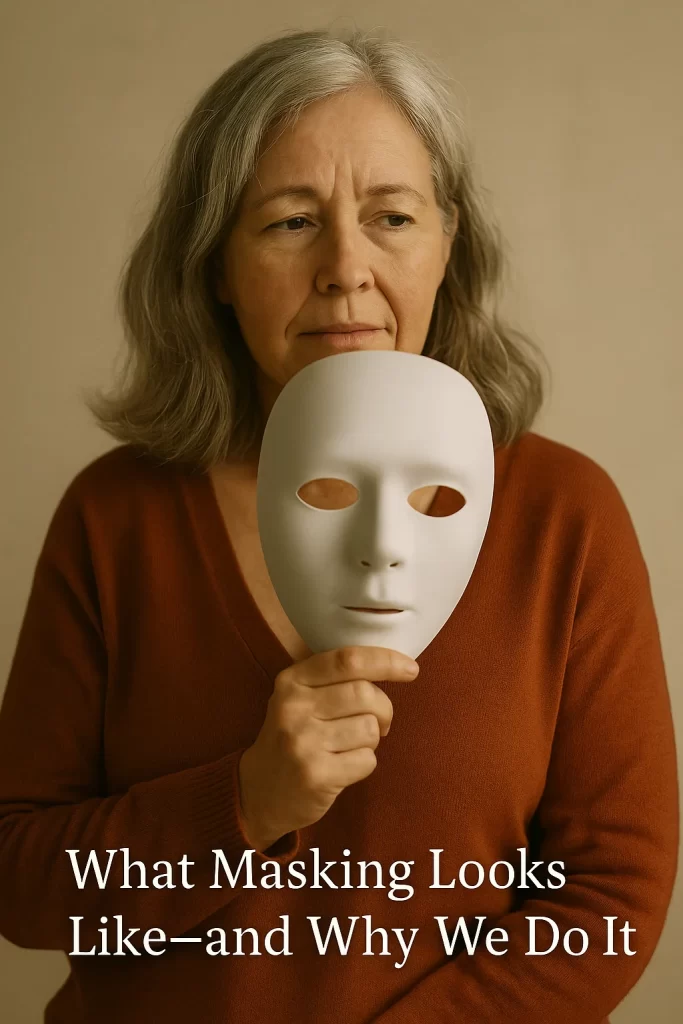
“Masking is not just something you do. It’s something you’ve learned to become—so well, you may have forgotten there’s anything beneath it.”
For many women 50+, masking has been an unspoken survival strategy. It’s what helped you succeed in roles, relationships, and routines. It’s also what has quietly exhausted you.
Masking means performing a version of yourself that you believe is more acceptable, more manageable, more “normal.” It’s not deception. It’s adaptation. And when it begins in childhood or early adulthood, it becomes second nature.
How Does Masking Show Up?
- Over-apologizing, even when you haven’t done anything wrong
- Smiling when you’re actually anxious or confused
- Forcing yourself to socialize when you’d rather rest
- Being “the responsible one” who never needs help
- Avoiding emotional messiness—even your own
- Staying silent rather than risking misunderstanding
Why We Learn to Mask
We learn to mask to feel safe, loved, and included. In a society that rarely understands the depth, sensitivity, or sensory experiences of neurodivergent women, masking is often the only way to avoid rejection, punishment, or invisibility.
Over time, masking doesn’t just shape behavior—it reshapes identity. You start to believe that the mask is you.
And yet, a quiet exhaustion sets in. You begin to feel distant from your own life, unsure of who you are underneath the layers. Your body holds the tension. Your mind spins. Your heart aches.
What Is the Cost?
Masking for decades can lead to:
- Burnout that rest doesn’t fix
- Health issues with no clear cause
- Loneliness even in connection
- Suppressed creativity and intuition
- Emotional numbness or sudden overwhelm
And perhaps most deeply: a lingering feeling that something essential has been missing—but you can’t name it.
You Are Not Alone
If you’ve spent your life over-performing, over-giving, or shape-shifting, you are not broken. You are responding to a system that didn’t see you clearly.
This is not your fault.
The gift of naming masking is that you begin to reclaim what’s underneath. You start to soften, to breathe differently, to feel again. And with that feeling comes a new question:
If you didn’t have to perform anymore, who might you become?
That’s the question we’ll carry into the next part of this journey.
Not to fix what’s wrong—but to welcome what’s been waiting.
And that begins with safety.
This article is part of a 7-part series guiding women 50+ through the hidden experiences of neurodivergence, leading toward a reflective survey and, ultimately, a deeper reconnection to self.