For years, I heard people use the word “trauma-informed” like it was a badge of compassion.
They’d say things like:
“We’re a trauma-informed school.”
“I took trauma-informed training.”
Or, “I’m being trauma-informed with my clients.”
And I used to say the same.
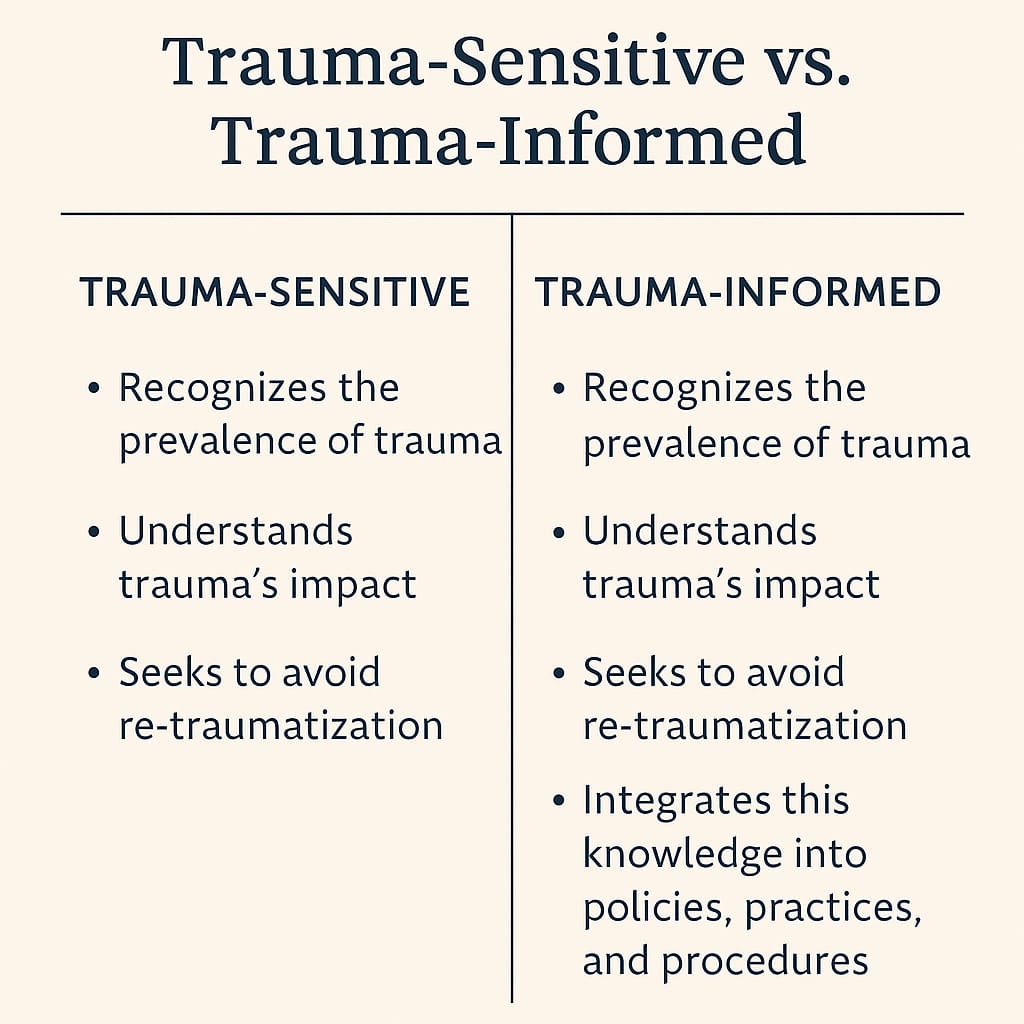
But what I’ve come to realize is that most of what we call “trauma-informed”… is really trauma-sensitive. And there’s a big difference.
What is Trauma-Sensitive?
Being trauma-sensitive means:
You recognize that people carry trauma in their bodies and minds.
You try to respond with gentleness, kindness, or more patience.
You make small adjustments—maybe you lower your voice, give someone space, or offer a grounding tool.
This is a beautiful start. It matters. It creates moments of safety.
But on its own, it isn’t enough.
What is Trauma-Informed?
Being trauma-informed means you’ve gone deeper.
It’s not just about noticing someone’s pain—it’s about understanding what created it, and how systems (inner and outer) need to change for real healing to happen.
Trauma-informed care:
Doesn’t expect people to “regulate” without support.
Doesn’t push past silence or shutdown.
Doesn’t punish someone for how they survived.
It asks:
What does this nervous system need to feel safe again?
And it listens—not just once, but every time.
It Starts With Us
Being trauma-informed isn’t just for teachers or counselors or caregivers.
It’s for all of us who are trying to heal.
It’s for anyone who’s ever said:
“Why do I react this way?”
“Why do I shut down when things get hard?”
“Why can’t I just move on?”
When we become trauma-informed with ourselves, we stop blaming the parts of us that are still in pain. We stop shaming the survival patterns that once kept us alive.
We start creating inner safety—and that’s when true transformation begins.
The Path Forward
If you’ve experienced trauma, you deserve more than sensitivity.
You deserve to be held in environments—inside your body and outside in the world—that understand trauma, honor your pace, and help you feel whole again.
That’s what trauma-informed care is about.
Not just information.
Not just intention.
But real safety—for yourself, and for others.
It’s time.
Written with love,
Loretta Mohl
Founder, Focused Intention Technique (FIT)