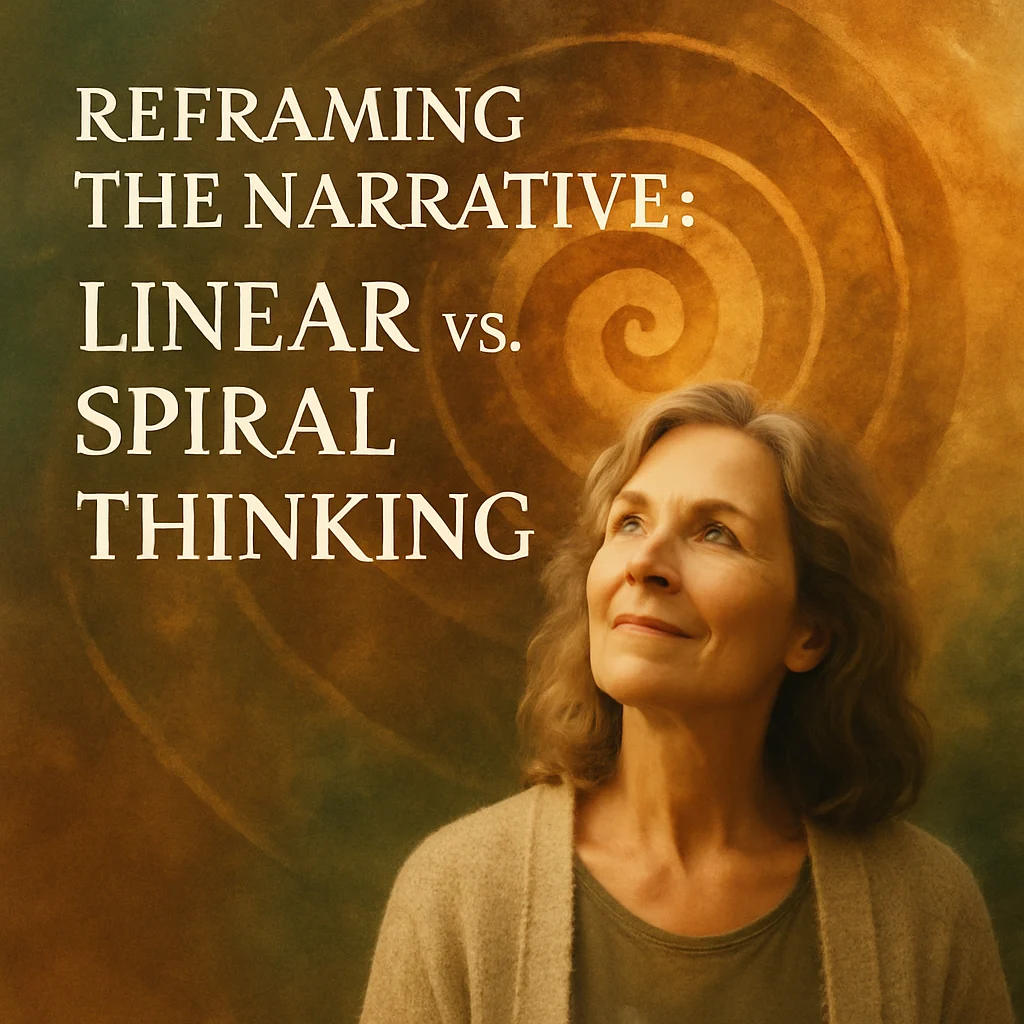
“What if the way you think isn’t a problem to solve, but a pattern to reclaim?”
For women who have long felt out of sync with the world around them, the disconnect may not be personal—it may be structural. Our society prizes linear thinking: straight lines, fixed timelines, and step-by-step progressions. If your mind works differently, you may have spent decades believing something was wrong with you.
But what if the problem wasn’t your thinking, but the box your thinking was asked to fit into?
Linear Thinking: The Cultural Standard
Linear thinking is prized in Western culture. It moves forward. It values productivity. It defines success through measurable outcomes. Schools reward it. Corporations demand it. Healthcare systems structure their protocols around it.
Linear thinkers often:
- Prefer step-by-step logic
- Focus on goals and completion
- Think in timelines and hierarchies
- Require clear beginnings and endings
This model works well in systems built around performance, order, and control. But it doesn’t work for everyone. And it doesn’t reflect how nature works.
Spiral Thinking: A Different Kind of Intelligence
Spiral thinking doesn’t move in straight lines. It moves in layers. Cycles. Patterns. It deepens. It returns. It evolves.
Spiral thinkers often:
- Process through emotion, intuition, or metaphor
- Revisit ideas repeatedly, finding new meaning each time
- Struggle with rigid timelines but thrive in open exploration
- Value relationships and resonance over outcomes
Sound familiar?
Spiral thinking is common among neurodivergent women—especially those who feel deeply, sense more than they can explain, or need time to integrate. It’s not a flaw. It’s a form of brilliance that the linear world rarely makes space for.
The Cost of Misfitting
When spiral thinkers are raised in linear systems, they often:
- Feel slow, scattered, or disorganized
- Struggle with structure and deadlines
- Learn to mistrust their own process
- Mask their true thinking to appear “on track”
They internalize the belief: I must be wrong.
But spiral thinking is not wrong. It is rhythmic. It is ancient. It mirrors the natural world: seasons, moons, tides, breath, blood, birth, transformation.
Returning to the Spiral
To reclaim spiral thinking is to remember that healing, creativity, and consciousness don’t unfold in straight lines. They move in waves. In returns. In sacred repetition.
When we allow ourselves to spiral, we:
- Heal in layers
- Reclaim intuitive knowing
- Soften into presence
- Let go of performance
This is not regression. It’s refinement.
You are not going in circles. You are going deeper.
Why It Matters Now
For women over 50, especially those beginning to question the masks they’ve worn, understanding their thinking style is crucial. Recognizing spiral intelligence helps dismantle decades of self-doubt.
You were never behind. You were never too much. You were simply spiraling inward while the world demanded a straight line.
Now, you get to choose:
Do you keep trying to fit into a world that misunderstands you?
Or do you spiral deeper into the truth of who you really are?
Linear Thinking: The Cultural Standard
Linear thinking is prized in Western culture. It moves forward. It values productivity. It defines success through measurable outcomes. Schools reward it. Corporations demand it. Healthcare systems structure their protocols around it.
Linear thinkers often:
- Prefer step-by-step logic
- Focus on goals and completion
- Think in timelines and hierarchies
- Require clear beginnings and endings
This model works well in systems built around performance, order, and control. But it doesn’t work for everyone. And it doesn’t reflect how nature works.
Spiral Thinking: A Different Kind of Intelligence
Spiral thinking doesn’t move in straight lines. It moves in layers. Cycles. Patterns. It deepens. It returns. It evolves.
Spiral thinkers often:
- Process through emotion, intuition, or metaphor
- Revisit ideas repeatedly, finding new meaning each time
- Struggle with rigid timelines but thrive in open exploration
- Value relationships and resonance over outcomes
Sound familiar?
Spiral thinking is common among neurodivergent women—especially those who feel deeply, sense more than they can explain, or need time to integrate. It’s not a flaw. It’s a form of brilliance that the linear world rarely makes space for.
The Cost of Misfitting
When spiral thinkers are raised in linear systems, they often:
- Feel slow, scattered, or disorganized
- Struggle with structure and deadlines
- Learn to mistrust their own process
- Mask their true thinking to appear “on track”
They internalize the belief: I must be wrong.
But spiral thinking is not wrong. It is rhythmic. It is ancient. It mirrors the natural world: seasons, moons, tides, breath, blood, birth, transformation.
Returning to the Spiral
To reclaim spiral thinking is to remember that healing, creativity, and consciousness don’t unfold in straight lines. They move in waves. In returns. In sacred repetition.
When we allow ourselves to spiral, we:
- Heal in layers
- Reclaim intuitive knowing
- Soften into presence
- Let go of performance
This is not regression. It’s refinement.
You are not going in circles. You are going deeper.
Why It Matters Now
For women over 50, especially those beginning to question the masks they’ve worn, understanding their thinking style is crucial. Recognizing spiral intelligence helps dismantle decades of self-doubt.
You were never behind. You were never too much. You were simply spiraling inward while the world demanded a straight line.
Now, you get to choose:
Do you keep trying to fit into a world that misunderstands you?
Or do you spiral deeper into the truth of who you really are?
This companion article supports the 7-part series exploring late-identified neurodivergence in women 50+. If this resonates, keep exploring. You might be surprised where the spiral leads.